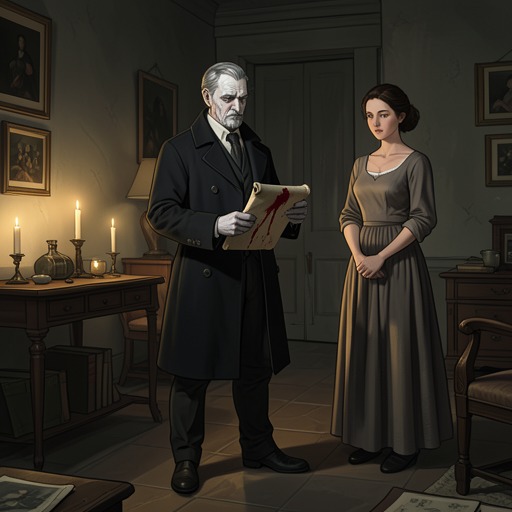
Isabella of Vicenza
The Castle of OtrantoIsabella of Vicenza enters the story as the daughter of Frederic, Marquis of Vicenza, and the intended bride of Conrad. When Conrad dies before their marriage, Manfred turns the alliance into a personal proposal, and Isabella’s flight from his authority carries the dispute over her future into the larger struggle for Otranto. She ultimately marries Theodore, whose revealed descent from Alfonso makes him the rightful heir, joining her to the restored ruling line after the destruction of Manfred’s hopes.
Identity and Political Background
At eighteen, Isabella has been delivered to Manfred by her guardians so that he can celebrate her marriage to Conrad when the young prince’s health permits. The arrangement is more than a private match: Manfred expects the marriage to unite his house with the house of Vicenza. He has arranged it while Frederic is absent, and later admits that he bribed Isabella’s guardians to secure her for his son.
The broader uncertainty surrounding Otranto gives the match its political weight. Frederic claims descent from Alfonso the Good, the former ruler of Otranto, while Manfred’s family holds power through succession from Ricardo. Manfred represents the planned wedding as an alliance between the two houses; Frederic’s herald instead describes Isabella’s delivery into Manfred’s hands as an abuse of her father’s absence and demands both her return and Manfred’s surrender of the principality. Isabella is thus at once a person whose marriage is repeatedly decided by others and the living link through which rival dynastic claims might be joined.
From Intended Bride to Fugitive
Conrad’s death overturns the arrangement before the wedding can take place. In the immediate aftermath, Isabella responds to the family’s loss with concern rather than an attempt to secure a new match. She asks to remain under Manfred’s roof until her father returns, offering to help comfort Manfred, Hippolita, and Matilda. Manfred rejects that temporary role: he tells her that Hippolita is no longer his wife and offers himself to Isabella in place of his dead son.
Isabella refuses to treat Manfred’s proposal as a legitimate continuation of the earlier agreement. She points to his roles as her prospective father-in-law, Conrad’s father, and Hippolita’s husband, and is alarmed when he declares that he will divorce Hippolita. Once she leaves him, fear of his pursuit and the locked castle gates make escape difficult. She remembers a subterranean passage leading from the castle vaults to the church of St. Nicholas and hurries toward its altar, where she expects the right of sanctuary to protect her. Her flight is a deliberate appeal to religious protection against the prince’s control of the castle and his household.
Isabella reaches sanctuary and asks to remain there until she can learn whether Frederic is alive. Through Jerome, she sends Manfred and Hippolita a message thanking them for their kindness, mourning Conrad’s death, and expressing respect for them as parents, while asking permission to stay at the church until she receives news of her father or is free to choose a suitable marriage with her guardians’ approval. Manfred refuses to consent and insists that she return, claiming responsibility for her person. Jerome challenges the propriety of that claim now that Manfred has sought to marry her himself. The exchange makes clear that Isabella’s safety depends not on Manfred’s hospitality but on the church’s competing authority.
Frederic’s Claim and the Marriage Bargain
The news of Isabella’s flight becomes part of the confrontation between Manfred and Frederic’s representatives. The herald demands Isabella for her father and calls on Manfred to surrender Otranto, arguing that Frederic is nearest in blood to Alfonso. Manfred knows the Vicenza claim is substantial, although he contests its basis: he insists that Ricardo received Otranto from Alfonso and that his own family has held it since. His account of inherited possession stands against the herald’s claim of closer blood descent.
Manfred’s response exposes how thoroughly he treats marriage as a tool of rule. He had first sought Isabella for Conrad to unite the two houses; after Conrad’s death, he proposed to marry her himself. When Frederic arrives, Manfred considers seeking his consent to that marriage, while also concealing Isabella’s flight from the visitors. Later, Hippolita proposes a different union: she believes the signs of the previous two days indicate that Otranto will pass from Manfred to Frederic, and hopes marriage between the rival houses may avert their family’s complete ruin. She offers Matilda to Frederic, not Isabella to Manfred. The proposed settlement shifts the political bargain, but neither arrangement gives Isabella control over the competing dynastic plans.
Recognition and Dynastic Resolution
When the wounded Frederic opens his eyes, he asks whether the woman before him is Isabella of Vicenza. She confirms that she is, and he identifies himself as her father before he can say more. Their recognition restores the father-daughter relationship that had been obscured by his reported death and her guardians’ decision to deliver her to Manfred. It also gives personal force to Frederic’s political demand: Isabella is not simply a prospective bride but his daughter, whose return he seeks as he asserts his claim to Otranto.
The final revelation changes the succession more decisively than any proposed marriage. Jerome recounts that Alfonso was driven to Sicily, married Victoria there, and left her pregnant when he resumed his journey. Victoria’s daughter later married Jerome; Theodore is their son. Manfred accepts the account and yields Otranto to Theodore, recognizing him as Alfonso’s heir. With Manfred and Hippolita entering religious life, Frederic offers Isabella to the new prince. Theodore initially remains too grief-stricken over Matilda to contemplate another love, but repeated conversations with Isabella about Matilda eventually persuade him to accept a life with Isabella, in which he can continue to remember the woman he lost. Isabella’s marriage therefore follows the restoration of Theodore’s dynastic right; it seals the settlement after the claim to Otranto has been resolved through revealed descent and Manfred’s abdication.